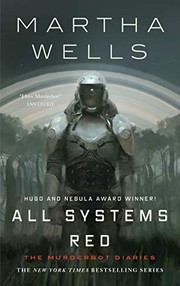
All Systems Red is a 2017 science fiction novella by American author Martha Wells. The first in a series called The Murderbot Diaries, it was published by Tor.com. The series is about an artificial construct designed as a Security Unit, which manages to override its governor unit, thus enabling it to develop independence. It calls itself Murderbot, and likes to watch unrealistic soap operas. As it spends more time with some caring humans, it starts developing feelings that it does not care for.
This introduction to Murderbot is swift, concise, and light. While I read it in a single two-and-a-half-hour sitting, I wouldn't say it hooked me. Rather, it provided the same level of entertainment as a run-of-the-mill genre film. Martha Wells delivers on her authorial promise but doesn't offer compelling prose, deep character work, or much in the way of worldbuilding. I found myself underwhelmed, especially after the endless hype I've heard over the past few years. This is another classic case of "I'm not the target audience".
J'ai commencé par la série #Apple avant de découvrir le livre... On sent bien la différence. Le livre est court et se lit vite, et pose les bases d'un univers intéressant, posant plus de questions que de réponses. On verra les tomes suivants !
En revanche, la traduction... Avec des "iel" à toutes les sauces, je hais cette mode. Dans mon dictionnaire français, il existe "il", "elle", et pour les objets, il existe "ça". Ce style de traduction n'est spécifié nulle part. Si j'avais su, j'aurais pris la VO. J'ai les yeux qui saignent à chaque fois que je tombe dessus, avec une très forte envie de le corriger... Pourquoi ne pas faire une édition "vieux cons" et une édition "jeunes woke avec orthographe 90 en prime", afin que chacun ait ce qui lui convient ?
After finishing the show (which has been renewed for a second season!) I thought I'd go back and check out the original to recall exactly what changes they made for the screen.
There weren't many — the show is pretty darn close to the novella. I guess having such tight clean source material means there isn't as much you need to cut. A lot of it was pretty streamlined — a couple of characters were merged, human thoughts and feelings get more screen time, making it more of an ensemble piece, and the addition of Leebeebee to make Murderbot more visually scary for us.
There's less detail to the tech/interface/hacking/hub system interactions. I don't think I've ever seen a hacking scene I really liked which both felt genuine and was visually interesting. (If you're wondering, the two best onscreen hacks are:
1. Trinity's use of nmap and the SSH1 CRC32 …
After finishing the show (which has been renewed for a second season!) I thought I'd go back and check out the original to recall exactly what changes they made for the screen.
There weren't many — the show is pretty darn close to the novella. I guess having such tight clean source material means there isn't as much you need to cut. A lot of it was pretty streamlined — a couple of characters were merged, human thoughts and feelings get more screen time, making it more of an ensemble piece, and the addition of Leebeebee to make Murderbot more visually scary for us.
There's less detail to the tech/interface/hacking/hub system interactions. I don't think I've ever seen a hacking scene I really liked which both felt genuine and was visually interesting. (If you're wondering, the two best onscreen hacks are:
1. Trinity's use of nmap and the SSH1 CRC32 exploit in Matrix Reloaded, which is realistic but visually mundane and only appears on screen for a few moments, making it more of an easter egg than anything else, and
2. Hugh Jackman assembling a hacking cube from an ancient server in Swordfish, none of which has any relationship to reality, but which is very flashy on screen and includes Hugh Jackman.
The biggest thing which felt different to me was the absence of Murderbot's ubiquitous use of micro drones and remote cameras as extensions of its sensorium. In the novella, I really felt like Murderbot was deeply connected to the feed and that looking through a remote camera or accessing a database was was as natural for it as reaching out a hand or looking in a particular direction is for us. There were definitely nods to this — it wasn't exactly forgotten — but it was considerably less ubiquitous and visceral than in the novella.
And I think this contributed to making it more of an ensemble piece. In the novellas, the reader doesn't have any senses: we're not watching or listening. We are reading an account composed by someone whose sensorium & perception are comprehensible but alien to us — like reading a cuttlefish talk about light polarization and how it's using chromatophores. And in fact I think that this is one of the deep strengths of the series. Murderbot is a killing machine with guns in its arms who experiences the world through drones & feeds and minimal fear of pain or death. But also, it's an autistic nerd treated as less than a person in a corporate dystopia and just wants to be left alone to watch its shows, just like the reader.
Anyway, this novella continues to delight. If you enjoyed the show and like to read, check it out. The books are very short and easy to get into, which makes it very easy to start and equally disappointing when you run out.