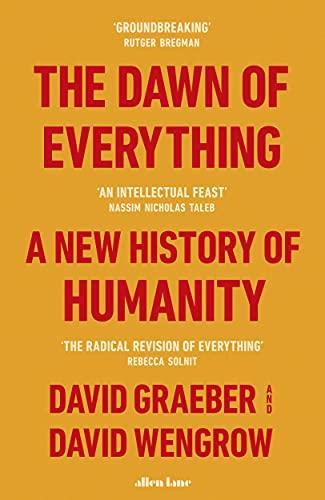
A breathtakingly ambitious retelling of the earliest human societies offers a new understanding of world history
For generations, our remote ancestors have been cast as primitive and childlike - either free and equal, or thuggish and warlike. Civilization, we are told, could be achieved only by sacrificing those original freedoms or, alternatively, by taming our baser instincts. David Graeber and David Wengrow show how such theories first emerged in the eighteenth century as a reaction to indigenous critiques of European society, and why they are wrong. In doing so, they overturn our view of human history, including the origins of farming, property, cities, democracy, slavery and civilization itself.
Drawing on path-breaking research in archaeology and anthropology, the authors show how history becomes a far more interesting place once we begin to see what's really there. If humans did not spend 95 per cent of their evolutionary past in tiny bands …
A breathtakingly ambitious retelling of the earliest human societies offers a new understanding of world history
For generations, our remote ancestors have been cast as primitive and childlike - either free and equal, or thuggish and warlike. Civilization, we are told, could be achieved only by sacrificing those original freedoms or, alternatively, by taming our baser instincts. David Graeber and David Wengrow show how such theories first emerged in the eighteenth century as a reaction to indigenous critiques of European society, and why they are wrong. In doing so, they overturn our view of human history, including the origins of farming, property, cities, democracy, slavery and civilization itself.
Drawing on path-breaking research in archaeology and anthropology, the authors show how history becomes a far more interesting place once we begin to see what's really there. If humans did not spend 95 per cent of their evolutionary past in tiny bands of hunter-gatherers, what were they doing all that time? If agriculture, and cities, did not mean a plunge into hierarchy and domination, then what kinds of social and economic organization did they lead to? The answers are often unexpected, and suggest that the course of history may be less set in stone, and more full of playful possibilities than we tend to assume.
The Dawn of Everything fundamentally transforms our understanding of the human past and offers a path toward imagining new forms of freedom, new ways of organizing society. This is a monumental book of formidable intellectual range, animated by curiosity, moral vision and faith in the power of direct action.
Torno a reprendre la lectura d'aquesta obra excepcional. Vaig per la meitat i no hi ha apartat que no em deixi bocabadada. Vaig fer una aturada per poder pair el primer volum de "A la recerca del temps perdut".
No logro determinar cuánto tiempo he tardado en leer 'El amanecer de todo', pero puedo asegurar que han sido al menos dos años. Es, sin duda, el mayor reto al que me he enfrentado en lo referente a la lectura y me he encontrado aparcando el libro durante meses por sentirme incapaz de reunir la lucidez necesaria para absorber todo lo que propone. Dicho esto, le pongo cinco estrellas porque no le puedo poner más.
Estoy plenamente convencido de que si se pudiese obligar a una parte importante de la población a leer una versión simplificada y resumida de este ensayo, la clarividencia de lo que explica tendría la fuerza suficiente como para cambiar en gran parte este orden social que nos arrastra hacia el precipicio a marchas forzadas. Aceptar un sistema que devora las vidas de la práctica totalidad de los seres vivos del planeta pasa por erradicar la …
No logro determinar cuánto tiempo he tardado en leer 'El amanecer de todo', pero puedo asegurar que han sido al menos dos años. Es, sin duda, el mayor reto al que me he enfrentado en lo referente a la lectura y me he encontrado aparcando el libro durante meses por sentirme incapaz de reunir la lucidez necesaria para absorber todo lo que propone. Dicho esto, le pongo cinco estrellas porque no le puedo poner más.
Estoy plenamente convencido de que si se pudiese obligar a una parte importante de la población a leer una versión simplificada y resumida de este ensayo, la clarividencia de lo que explica tendría la fuerza suficiente como para cambiar en gran parte este orden social que nos arrastra hacia el precipicio a marchas forzadas. Aceptar un sistema que devora las vidas de la práctica totalidad de los seres vivos del planeta pasa por erradicar la posibilidad de imaginar siquiera una alternativa. La humanidad se organiza así porque estamos programadas para ello, se nos dice, pero Graeber y Wengrow desmontan indiscutiblemente este dogma con pruebas no solo irrefutables, sino también -y quizá sobre todo- muy inspiradoras.
Leed 'El amanecer de todo', regalad 'El amanecer de todo' y contadle a todo el mundo que no tenemos por qué malvivir de esta forma.
There are several flaws in this book.
We already know this. The theory Graeber and Wengrow put forward has been in vogue for nearly half a century. It's not new and it even is cliched. No one really thinks the analytic constructs of the theories of the State correspond to actual historical truth, not even the original theorizers thought like that. Its influence is another thing.
Speaking of influence, the authors again try to conjure up a false categorical connection between how a certain concept emerged, and whether this concept is really in the object that those made heavy use of it. This, coupled with a complete overlooking of medieval history and scholastic developments in the field of jurisprudence, led them to devise a totalizing narrative that while reducing the principle underlying the status quo to contingency, and simultaneously totalize the so-called freedom of the native Americans (ironically just like …
There are several flaws in this book.
We already know this. The theory Graeber and Wengrow put forward has been in vogue for nearly half a century. It's not new and it even is cliched. No one really thinks the analytic constructs of the theories of the State correspond to actual historical truth, not even the original theorizers thought like that. Its influence is another thing.
Speaking of influence, the authors again try to conjure up a false categorical connection between how a certain concept emerged, and whether this concept is really in the object that those made heavy use of it. This, coupled with a complete overlooking of medieval history and scholastic developments in the field of jurisprudence, led them to devise a totalizing narrative that while reducing the principle underlying the status quo to contingency, and simultaneously totalize the so-called freedom of the native Americans (ironically just like Rousseau, and even more like Tacitus) as if it itself is not contingent. Everyone with a knowledge of the development and evolution of the concept of state will find the narrative given extremely confused and stupid. History is contingent, but nearly everything is historically conditioned, and this contingency is not something that can be gotten rid of instantly and on a whim. There are too many a-historical and pseudo-historical arguments in the guise of history (similar to the current status of historical studies in humanities). In fact Greber and Wengrow go full totalizing mode and blatantly make noramtive value claims when it comes to the views that they themselves deem right, without actually arguing for that, since they'll find that when they really go on and try to do that, they'll be repeating what the thinkers of the 17th and 18th century said.
Furthermore, this book, similar to all other popular, propagandizing, rhetoric-driven book, gives a false impression that history is a simple thing which is more about facts rather than interpretations. Everyone with a minimum real education in any of the humanities will be able to see clearly that what are presented here are not and should not be the final words, but this is not and will not be the case for the general public, who are the majority of the readers of the book.
I'm not against the "against totalising state" narrative, but I'm against intellectual confusion and rhetoric devoid of any meaningful content. Pointing out that a community is "imaginary" may give those who fall into the rhetoric a false impression that there must be something real that holds a community together, but they won't stop and try to think about what then is this real thing that holds a community together - it must not be blood I guess. Similarly, the book's narrative never venture toward its almost necessary intellectual conclusion, or rather, it tries to give a conclusion that not at all follows from the archaeological studies etc. presented in it as evidences to something that is vague and in itself imaginary.
The authors warn that their conclusions might be discouraging, because they (convincingly) show that our present predicament was not inevitable—that we could have chosen to make a different world, but didn't. What I found discouraging (or at least bracing) is how the authors show that the task ahead of us—to make a more just world—isn't just about subtracting "civilization" and returning to humanity's supposed egalitarian past. It will involve constructing something new that is contextual and tactical, and that needs constant maintenance.