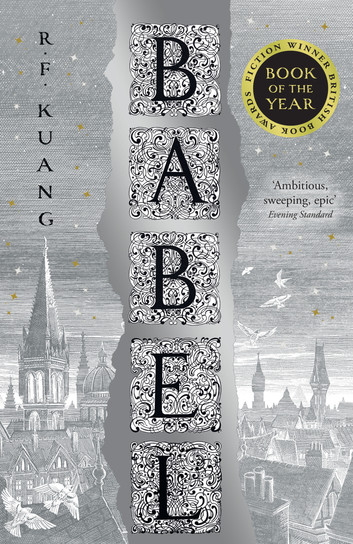
L‘histoire commence en 1828, à Canton. Un jeune orphelin chinois est recueilli par un professeur anglais et conduit à Londres. Déraciné mais aussi renommé en Robin Swift. Son nouveau tuteur s'applique à parfaire son éducation, linguistique, car Robin est destiné à intégrer le prestigieux Institut Royal de Traduction de l'Université d'Oxford, plus connu sous le nom de Babel.
Ne soyons pas trop romantiques. Non, le pouvoir de la barre repose dans les mots.
Plus précisément dans les aspects du langage que les mots sont incapables d'exprimer - ce qui se perd lorsqu'on passe d'une langue à une autre. L'argent capte le sens perdu et le réalise, le manifeste.
À Babel, Robin va nouer des relations fortes avec sa cohorte (les quatre élèves acceptés en première année), mais ses idées, et ses idéaux, vont aussi évoluer au fur et à mesure qu'il va être confronté au racisme ordinaire de la société anglaise et à son dédain des laissés pour compte tant de la colonisation anglaise que de la révolution de l'agentogravure.
Peut-il espérer changer Babel de l'intérieur ? Ou devra-t-il sacrifier ses rêves pour faire tomber cette institution ?
J'ai pris beaucoup de plaisir à lire ce roman, à découvrir une version d'Oxford qui n'est pas vraiment Oxford (mais qui l'est quand même beaucoup)… mais ce que j'en retient surtout, ce sont les thèmes abordés et les parallèles qu'on peut en faire avec notre monde réel.
Les thèmes principaux sont évidemment le colonialisme et le capitalisme, deux sytèmes intimement liés et qui se font au détriment des classes défavorisées tant de la société anglaise que des territoires de l'Empire. Hasard de mes lectures et de mes pérégrinations sur le web, alors que je commençais ma lecture de Babel début février, j'ai découvert en parcourant le blog de Ploum l'existence du mouvement luddite, un mouvement anglais du début du XIXe siècle qui a opposé les artisans aux employeurs, les conditions de vie des premiers empirant alors que les seconds s'enrichissaient. Évidemment, le mouvement a été sévèrement réprimé, et il est facile d'accuser les luddites d'être contre le progrès, et de lutter contre le sens de l'histoire… C'est d'ailleurs ce que Robin et ses camarades font la première fois qu'ils les rencontrent… mais l'intrigue (que je ne vous dévoilerait pas) les amènent à nuancer grandement cette opinion…
Partout, la révolution industrielle de l'argent apportait pauvreté, inégalités et souffrances, alors que seuls en bénéficiaient les individus de pouvoir au coeur de l'empire.
J'ai aussi beaucoup aimé tout ce qui lié aux langues et à l'étymologie, dans l'intrigue comme dans les nombreuses notes de bas de pages (d‘habitude, j'aime assez peu quand les notes de pages trop longues et trop nombreuses, mais dans Babel j'ai beaucoup aimé). L'introduction de l'argentogravure dans l'histoire de la révolution industrielle et de la colonisation anglaise induit que les langues du monde entier sont nécessaires à l'Empire, que c'est à la fois son moteur et son carburant… mais l'impérialisme anglais a pour conséquence d'appauvrir ces langues, en exploitant et en réprimant les peuples colonisés. Comme le dit à un moment l'une des protagoniste du roman, c'est la grande contradiction du colonialisme, il est conçu pour détruire ce qui a le plus de prix pour lui.
On essaie de déterminer le nombre de langues encore parlées dans le monde, et les endroits où elles meurent. Et il y en a énormément qui meurent. Un grand phénomène d'extinction s'est enclenché le jour où Christophe Colomb a posé le pied au Nouveau Monde.
L'espagnol, le portugais, le français, l'anglais ont pris la place des langues et dialectes régionaux comme autant de petits coucous. Il n'est pas inconcevable qu'un jour, la plus grande partie du monde ne parle qu'anglais.
Je sais que plusieurs lecteurs ont ressenti Babel comme manichéen, trop critique des blancs, trop anticolonialiste, trop antiraciste, voire trop anticolonialiste… mais je dois avouer que c'est ce qui, moi, m'a séduit. En anglais, l'oeuvre a un sous-titre, « or the necessity of violence », que je trouve particulièrement adapté car le livre porte, quelque part, la même réflexion que celle d'Andreas Malm dans Comment saboter un pipeline quand il s'interroge sur le choix de la violence ou de la non-violence dans les luttes passées et pour les mouvements actuels pour le climat. le monde et l'époque de Babel sont différents, certains, mais la notion de convergence des luttes contre le colonialisme, l'impérialisme et le capitaliste me parait tout à fait pertinente.
Un citation du roman fait d'ailleurs appel à un historien romain : Tacite
Auferre trucidare rapere falsis nominibus imperium atque ubi solitudinem faciunt pacem appellant.
Arracher, massacrer, voler, c'est ce qu'ils nomment empire pour nous tromper, et , quand ils font d'une terre un désert, ils appellent ça la paix.
Bref, j'allais dire que j'ai aimé Babel, mais non… enfin si, j'ai aimé le livre mais, surtout, j'ai aimé Oxford et j'ai aimé cette dystopie… parce qu'elle a su me passionner, mais aussi qu'elle résonne avec mes propres questionnements quant aux luttes actuelles. Je finirais mon billet sur une dernière citation tirée du livre… qui raisonne étrangement avec une citation de Dom Hélder Câmara que j'aime beaucoup.
C'est comme ça que fonctionne le colonialisme. II nous convainc que nous sommes responsables des conséquences de la résistance, que le choix immoral est la résistance elle-même plutôt que les circonstances qui l'ont provoquée.
www.6x8.org/2025/02/ma-critique-de-babel-de-rf-kuang/