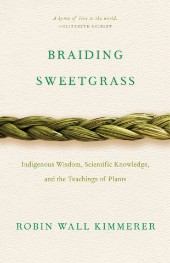
Updated with a new introduction from Robin Wall Kimmerer, the special edition of Braiding Sweetgrass, reissued in honor of the fortieth anniversary of Milkweed Editions, celebrates the book as an object of meaning that will last the ages. Beautifully bound in stamped linen cloth with a bookmark ribbon and a deckled edge, this edition features five brilliantly colored illustrations by artist Nate Christopherson. In increasingly dark times, we honor the experience that more than 350,000 readers in North America have cherished about the book--gentle, simple, tactile, beautiful, even sacred--and offer an edition that will inspire readers to gift it again and again, spreading the word about scientific knowledge, indigenous wisdom, and the teachings of plants.
As a botanist, Robin Wall Kimmerer has been trained to ask questions of nature with the tools of science. As a member of the Citizen Potawatomi Nation, she embraces the notion that plants and animals …
Updated with a new introduction from Robin Wall Kimmerer, the special edition of Braiding Sweetgrass, reissued in honor of the fortieth anniversary of Milkweed Editions, celebrates the book as an object of meaning that will last the ages. Beautifully bound in stamped linen cloth with a bookmark ribbon and a deckled edge, this edition features five brilliantly colored illustrations by artist Nate Christopherson. In increasingly dark times, we honor the experience that more than 350,000 readers in North America have cherished about the book--gentle, simple, tactile, beautiful, even sacred--and offer an edition that will inspire readers to gift it again and again, spreading the word about scientific knowledge, indigenous wisdom, and the teachings of plants.
As a botanist, Robin Wall Kimmerer has been trained to ask questions of nature with the tools of science. As a member of the Citizen Potawatomi Nation, she embraces the notion that plants and animals are our oldest teachers. In Braiding Sweetgrass, Kimmerer brings these two lenses of knowledge together to take us on "a journey that is every bit as mythic as it is scientific, as sacred as it is historical, as clever as it is wise" (Elizabeth Gilbert).
Drawing on her life as an indigenous scientist, and as a woman, Kimmerer shows how other living beings--asters and goldenrod, strawberries and squash, salamanders, algae, and sweetgrass--offer us gifts and lessons, even if we've forgotten how to hear their voices. In reflections that range from the creation of Turtle Island to the forces that threaten its flourishing today, she circles toward a central argument: that the awakening of ecological consciousness requires the acknowledgment and celebration of our reciprocal relationship with the rest of the living world. For only when we can hear the languages of other beings will we be capable of understanding the generosity of the earth, and learn to give our own gifts in return.
I found Robin's mixing of science, indigenous wisdom and spirituality extremely compelling. Each is given respect within the pages of this book, as are the plants, animals and other parts of the earth alongside the humans who share them. This book gives me hope for a future where we can live harmoniously with the world around use - people, plants, animals and lands.
I loved so much about this book, but it also made me so mad, and as a result, took me 3 months to finish listening to. There were so many anecdotes and tidbits from the author that I really appreciated and a lot of things I simply had never heard about before that I'm glad that I know now. It made me start to brainstorm ways that I can be more connected and take care of the earth better even though I live in a huge urban center. But at the same time, there was this really icky undertone of classism in some of the chapters that I really think made this book less. Perhaps this would go unnoticed by someone who hasn't been exposed to people from many different places before, or lived in many different types of environments before, but it was really noticeable to me. I also …
I loved so much about this book, but it also made me so mad, and as a result, took me 3 months to finish listening to. There were so many anecdotes and tidbits from the author that I really appreciated and a lot of things I simply had never heard about before that I'm glad that I know now. It made me start to brainstorm ways that I can be more connected and take care of the earth better even though I live in a huge urban center. But at the same time, there was this really icky undertone of classism in some of the chapters that I really think made this book less. Perhaps this would go unnoticed by someone who hasn't been exposed to people from many different places before, or lived in many different types of environments before, but it was really noticeable to me. I also found the author's somewhat interchangeable use of immigrant, settler, and colonialist, to be rather unsettling given the current political climate. I realize that this book is somewhat older, and that topics of Indigenous sovereignty can be fraught in the Americas and Australia in particular, but it nonetheless struck me as somewhat careless in contrast to how much care the author puts into expressing reciprocity in such explicit terms.
I was really excited about this book given how many good things I've heard about people who've read it in the past year so, but I'm feeling more on the negative side of lukewarm about it, which is a shame. Maybe I'll have to try it again at some point with some more education under my belt and see if I feel more positively about it then.